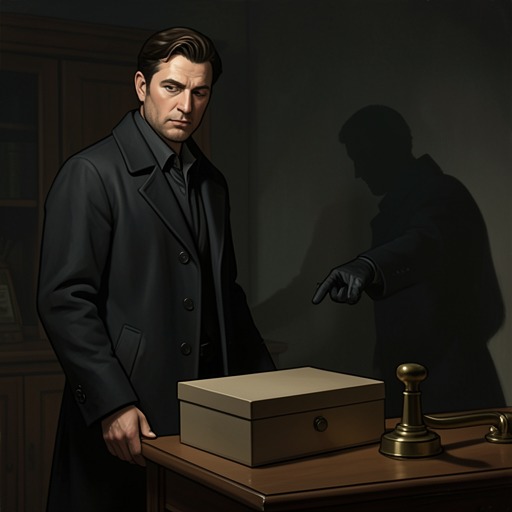
Esterhazy Spies for Germany
An Officer and a SpyEsterhazy Spies for Germany is the discovery that Charles Ferdinand Walsin Esterhazy, a serving French officer, was supplying information and sketches to Maximilian von Schwartzkoppen, the German attaché. The connection comes into view not through a confession or a complete file, but through fragments recovered from the attaché’s discarded papers: a torn Petit bleu bearing Esterhazy’s address and a damaged letter discussing sketches, payment, and the terms of their association. The evidence points toward espionage, yet its incompleteness leaves room for competing interpretations—and for the military response to become a second contest over what the documents mean.
The Petit bleu identifies a French officer
Captain Lauth brings Georges Picquart a thin manila folder several hours after Picquart has asked him to investigate. Inside is the Petit bleu, a postcard laboriously pieced back together. Its right edge remains jagged, with some pieces missing, but the message is legible. The sender, identified by the initial “C,” asks for a more detailed written explanation of a matter in hand before deciding whether to continue an association with the “house of R.” Picquart asks whether “C” is Schwartzkoppen; Lauth confirms that it is the attaché’s preferred code name.
The reverse makes the clue more consequential. Beneath the printed word “TELEGRAMME” and above “PARIS,” the address space names Major Esterhazy at 27, rue de la Bienfaisance. The card does not itself describe what Esterhazy has done, but it places him in direct correspondence with a figure Picquart associates with German intelligence. Picquart does not recognize the name. The sudden appearance of an unfamiliar officer in the evidence strikes him with the force of seeing an old friend’s name in a deaths column: a stark contrast between the ordinary address on a postal card and the possibility of betrayal it opens.
Picquart asks Lauth to check whether there is a Major Esterhazy in the French Army. Lauth has already consulted Gribelin and reports that Major Charles Ferdinand Walsin Esterhazy is listed with the 74th Infantry Regiment. Picquart recognizes the regiment as the “Seven-Four” and recalls that a friend serves there, in Rouen. When Lauth connects Rouen to the letter’s reference to the “house of R,” the possibility of another traitor becomes difficult to ignore. At this point, the address and military listing have identified a person to investigate; they have not, by themselves, established the full scope of his activity.
The damaged letter describes an exchange
A second document gives the suspicion more substance. It is incomplete, with gaps throughout its text, but the surviving lines discuss funds, conditions, a proposed tour, and a return to the recipient of sketches supplied earlier. The writer says the sketches are not the last. The signature is again “C.” Its material form matters: this is not a pristine, self-explanatory record, but a damaged text whose surviving details must be read together.
Picquart reads the letter several times. He understands it to describe Esterhazy handing information to the Germans, including sketches, in return for payment from Schwartzkoppen. The reference to the German attaché’s “father” is Picquart’s interpretation: he takes it to be a euphemism for a general in Berlin, who is objecting that the cost is too high for the value of the intelligence. The letter therefore suggests not only an exchange of information for money, but dissatisfaction within the receiving side about the value of what it is buying.
Lauth warns that the papers could be a trap. Picquart acknowledges the possibility: if Schwartzkoppen has realized that his discarded papers are being read, he could plant material to lead French intelligence astray. That qualification does not cancel the letter’s significance, but it prevents the recovered documents from becoming automatic proof. The source of the material, the gaps in the text, and the possibility of deliberate deception all bear on how confidently it can be interpreted.
Esterhazy’s conduct and the dispute over its importance
Picquart supplements the documents with information from his friend in Esterhazy’s regiment. The officer reportedly asks many suspicious questions, paid to attend artillery exercises, and had the firing manuals copied afterward. He is also described as desperate for money and a man of poor character. These details give the correspondence a possible operational context: Esterhazy’s interest in artillery and copied manuals sits alongside the letter’s reference to sketches and paid intelligence. They strengthen the suspicion, though they remain information relayed through Picquart’s contact rather than details written on the Petit bleu itself.
When Picquart discusses the case with Major Henry, Henry responds with studied calm. He notes that Esterhazy had worked at the intelligence bureau, a fact Picquart says Lauth never mentioned. Picquart regards that experience as making the case more serious, since training in intelligence techniques could matter to someone suspected of supplying information abroad. Henry instead argues that Esterhazy’s posting in Rouen would have left him without access to anything important. He reads the German letter’s threat to break off relations as evidence that the Germans did not consider Esterhazy a valuable source. For Henry, the correspondence diminishes the charge; for Picquart, it still describes an officer supplying information to a foreign power.
The disagreement is not simply over whether Esterhazy is a suspicious figure. It concerns what follows from evidence that appears incriminating but also indicates that the intelligence may have been of limited value. Henry cautions that an investigator can cause more damage by overreacting than a supposed traitor may have caused. Picquart rejects the implication that doubtful or low-value espionage can simply be left to continue. The episode thus places two judgments in tension: whether the evidence is reliable and serious enough to act on, and whether uncertainty warrants restraint or further investigation.
Significance of the discovery
The documents establish a trail that is specific but incomplete: an address linking Esterhazy to Schwartzkoppen, a letter that Picquart reads as describing paid transfers of information and sketches, and a regimental report of suspicious questions and copied artillery manuals. Taken together, these clues lead Picquart toward the conclusion that Esterhazy is the source involved in the German connection. Their force lies in their convergence, not in any one item serving as a complete account.
The discovery also changes the meaning of the investigation. A name previously unknown to Picquart now belongs to a French officer whose reported conduct and correspondence point toward Germany. But the immediate dispute with Henry shows how evidence can be contained by interpretation: the same German complaint that might indicate an active relationship can be presented as proof that the source is unimportant. The episode therefore establishes both the espionage suspicion and the institutional problem that follows it—the need to distinguish careful skepticism from the minimization of evidence that is inconvenient to pursue.